
What’s at Stake for Muni and BART in the November 2026 Election? |
Prop H and Measure RTM ask voters to balance transit service, recurring tax costs and accountability |
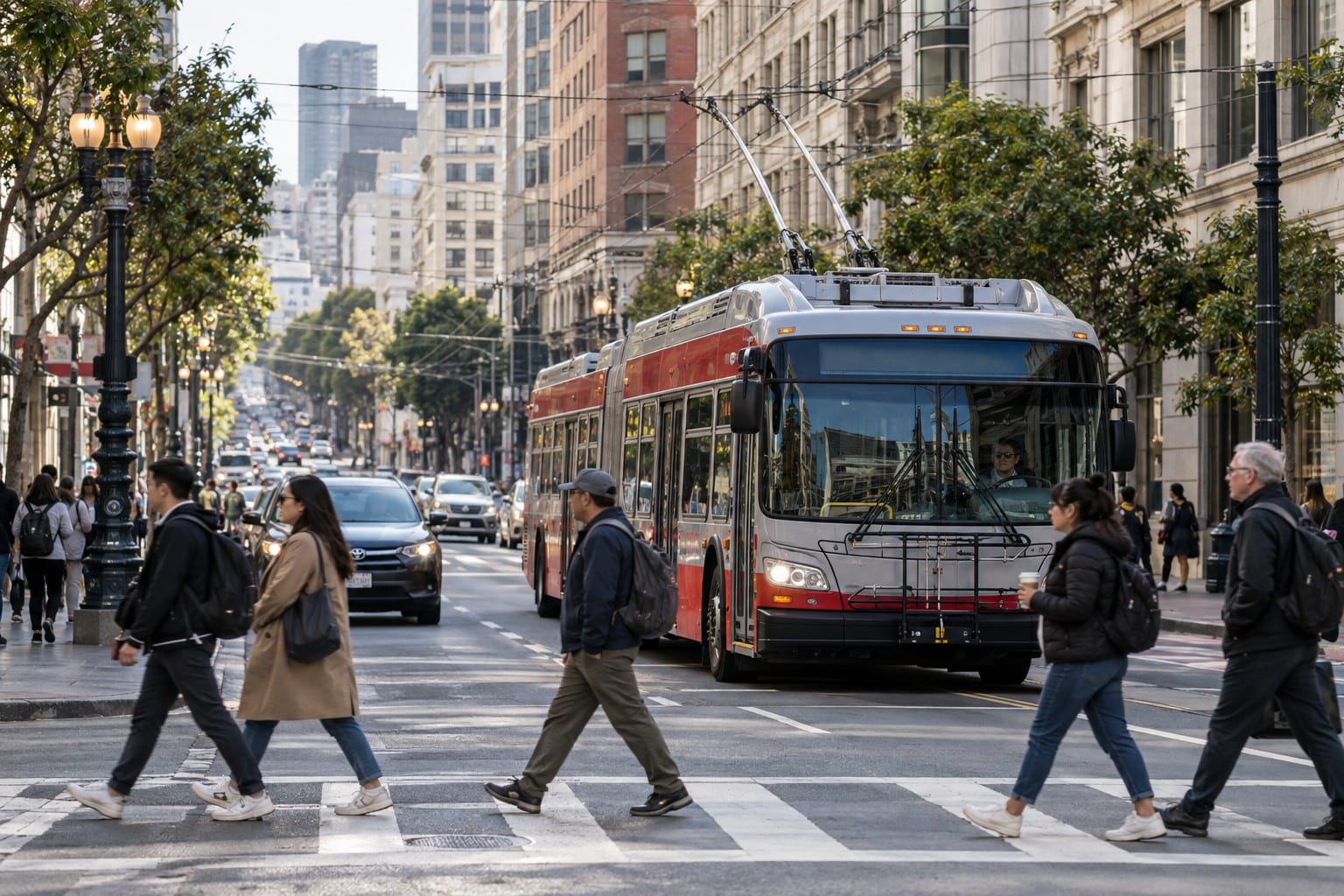
San Francisco’s November 3, 2026 election puts two different transit funding decisions in front of voters: a local parcel tax for Muni and a five-county sales tax supporting BART, Muni and other systems.
For riders, the stakes include waiting times and evening trips; for taxpayers, they include recurring bills and the question of how much accountability new revenue buys.
Prop H: a property tax for Muni
The city’s official ballot question identifies Proposition H as an annual parcel tax projected to raise $177 million a year for 15 years.
That estimate differs from earlier agency planning figures, so the ballot question is the reference point here.
SFMTA says the tax would begin July 1, 2027, and end June 30, 2042, with annual inflation adjustments.
An eligible, nonexempt single-family property with no more than 3,000 square feet of building area would start at $129 annually.
Larger homes pay additional amounts based on square footage; multifamily properties start at $249 and nonresidential properties at $799, with further charges for larger buildings.
The agency lists caps of $50,000 for multifamily parcels and $400,000 for nonresidential parcels, while single-family homes have no cap.
SFCTA’s explanation includes an exemption for qualifying owner-occupied senior homes and permits up to half the tax to be passed through to tenants in rent-controlled units.
Owners and renters should check their specific circumstances rather than treating $129 as everybody’s bill.
Measure RTM: a regional sales tax
The official election notice confirms a 14-year tax of 1% in San Francisco and 0.5% in Alameda, Contra Costa, San Mateo and Santa Clara counties.
In San Francisco, that means an additional $1 on a $100 taxable purchase, or $100 on $10,000 in taxable spending.
The measure’s estimated regional revenue is about $980 million annually, and the election notice requires a majority vote.
RTM supports multiple operators and rider improvements; Prop H’s local revenue is dedicated to Muni operations.
SFCTA describes the measures as complementary pieces of Muni’s funding strategy, alongside agency savings, rather than interchangeable solutions.
What could happen without new revenue?
SFMTA warns that inadequate funding could bring major cuts starting in fiscal 2027–28, including eliminating up to 20 routes, doubling waits on frequent services and reducing evening service by up to 60%.
These are agency contingency scenarios, not a finalized timetable of cancellations.
BART’s adopted fiscal 2027 budget describes a $375 million structural deficit and assumes the regional measure succeeds.
Its initially approved alternative plan includes 30-minute frequencies, a 9 p.m. closing time and 30% fare and parking increases beginning in January 2027 if no new funds become available.
Later reductions could include station closures, but no specific stations are named and further board decisions are required.
The case voters must weigh
The argument for new funding is practical: dependable service connects workers, students and people who cannot drive, while longer waits make everyday trips harder.
The agencies’ warnings also suggest that shrinking service can undermine the ridership needed to rebuild fare revenue.
The counterargument starts with household costs: a sales tax reaches taxable purchases by riders and nonriders alike, while the parcel tax adds a recurring property expense that can also affect renters.
Voters can reasonably ask whether promised efficiencies, audits and oversight will translate into measurable improvements.
SFMTA lists dedicated spending, citizen oversight, an independent audit and revenue reporting for the local measure; BART has also adopted financial-efficiency actions.
New revenue and disciplined management are separate tests, and neither should disappear from the discussion.
Before voting, compare the official tax terms with your own likely costs and read both sides’ ballot arguments.
Reporting checked October 13 for the Friday, October 16 publication target; service scenarios remain conditional.
Official sources: Prop H ballot question; SFMTA tax details; RTM election notice; SFCTA funding context; Muni contingency scenarios; BART adopted budget; BART alternative plan; BART further-approval requirements. |
0 Comments
Join the conversation
Be the first to comment
Share your thoughts above.